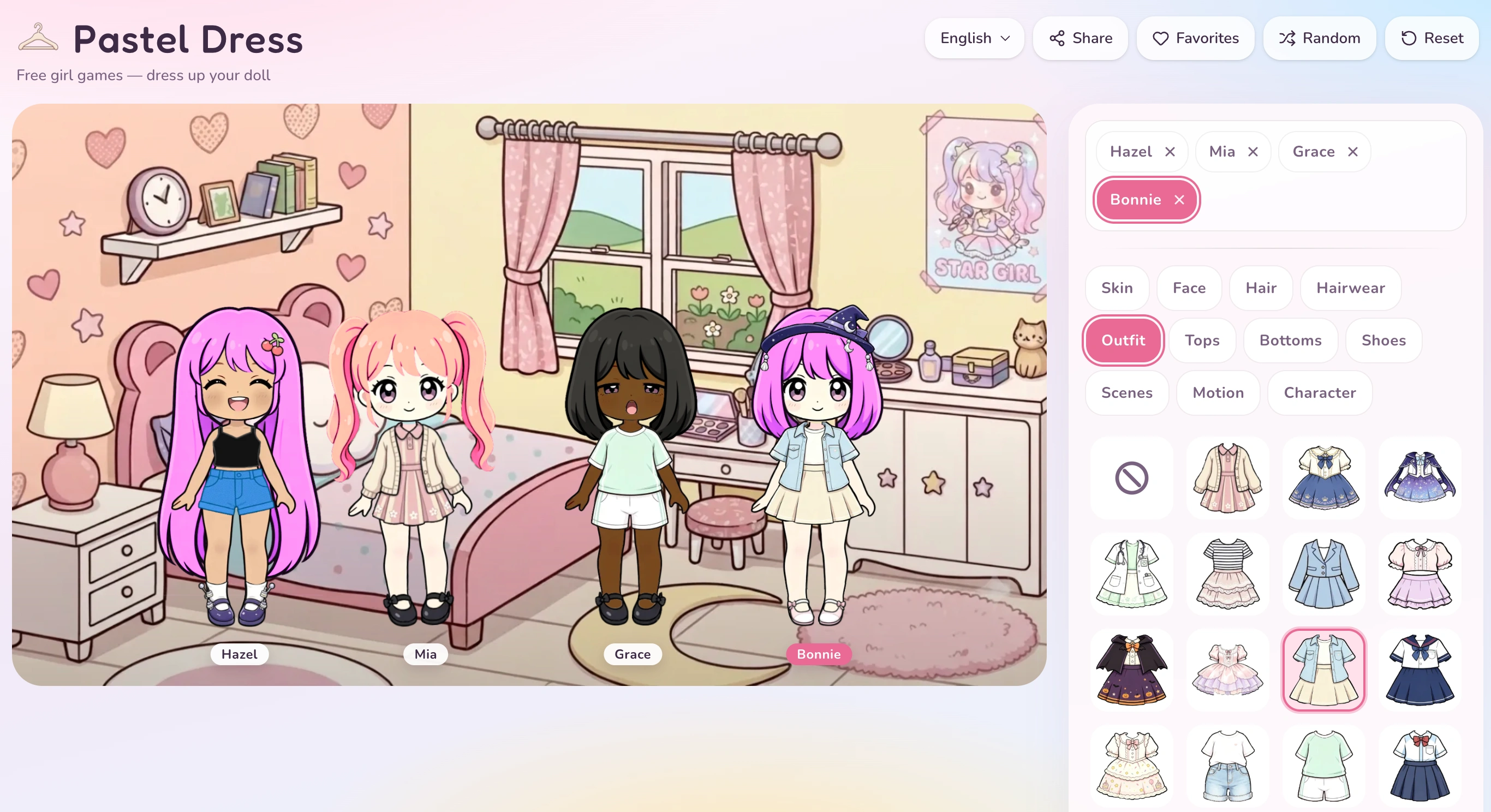
Pastel Dress is a free browser dress-up game. No account required — open it and play.
I wanted my daughter to be able to mix outfits and invent little stories by herself, quietly. It is also a small Fishenal Studio project.
I often buy her toys. From early on she loved dress-up character stickers. They are cheap, but after a few sessions she gets bored; some need hand assembly, and the supply is finite.
I still respect how those products are designed. The characters are cute; clothes and scenes are varied. They clearly work with artists over the long term.
I thought AI would make generating those images easy. It was not. I tried Gemini and Doubao. Each is good at different things: Gemini follows a brief more accurately but tends toward a realistic look; Doubao is closer to the cute style of the Chinese market. I used both together for a batch of scenes and characters. My daughter was excited, so I believed I could keep going. A computer also suits this kind of “disposable” play — endlessly expandable, with no physical wear or glue that fails.
Another push was that children are less fussy about toy quality. When she plays she does not care whether clothes align, whether they fit the figure, whether a hand sits on a handle when picking something up. They play roughly, because the real fun is in the imagination. Adults are different; they notice details, and if the details are weak they may decide the maker is not skilled enough.
Without that fear of detail, I let AI help write the code more freely. Before talking it through with AI, I had not figured out how to align clothes with the character. Recording coordinates for every asset would have been huge and messy. AI’s approach was simpler: make every asset the same size as a transparent WebP. No coordinates needed — even a tiny hairpiece lives inside a full rectangular frame.
Even then the work was not small. Dozens of images: I aligned them one by one in Pixelmator Pro, then exported in turn.
The worst technical pain was export. After grouping and aligning types of assets, I could not export every layer’s assets in one go. The old workflow was slice-and-export once; now everything stacked in one canvas as a single slice. I had to toggle visibility and export by hand, one after another — a huge chore. Talking with AI again, we decided it had to be scripted: Mac’s built-in automation, exporting one by one. More than a hundred assets took nearly half an hour. It looked as if the tool had to walk layer visibility one step at a time, and each export itself costs time.
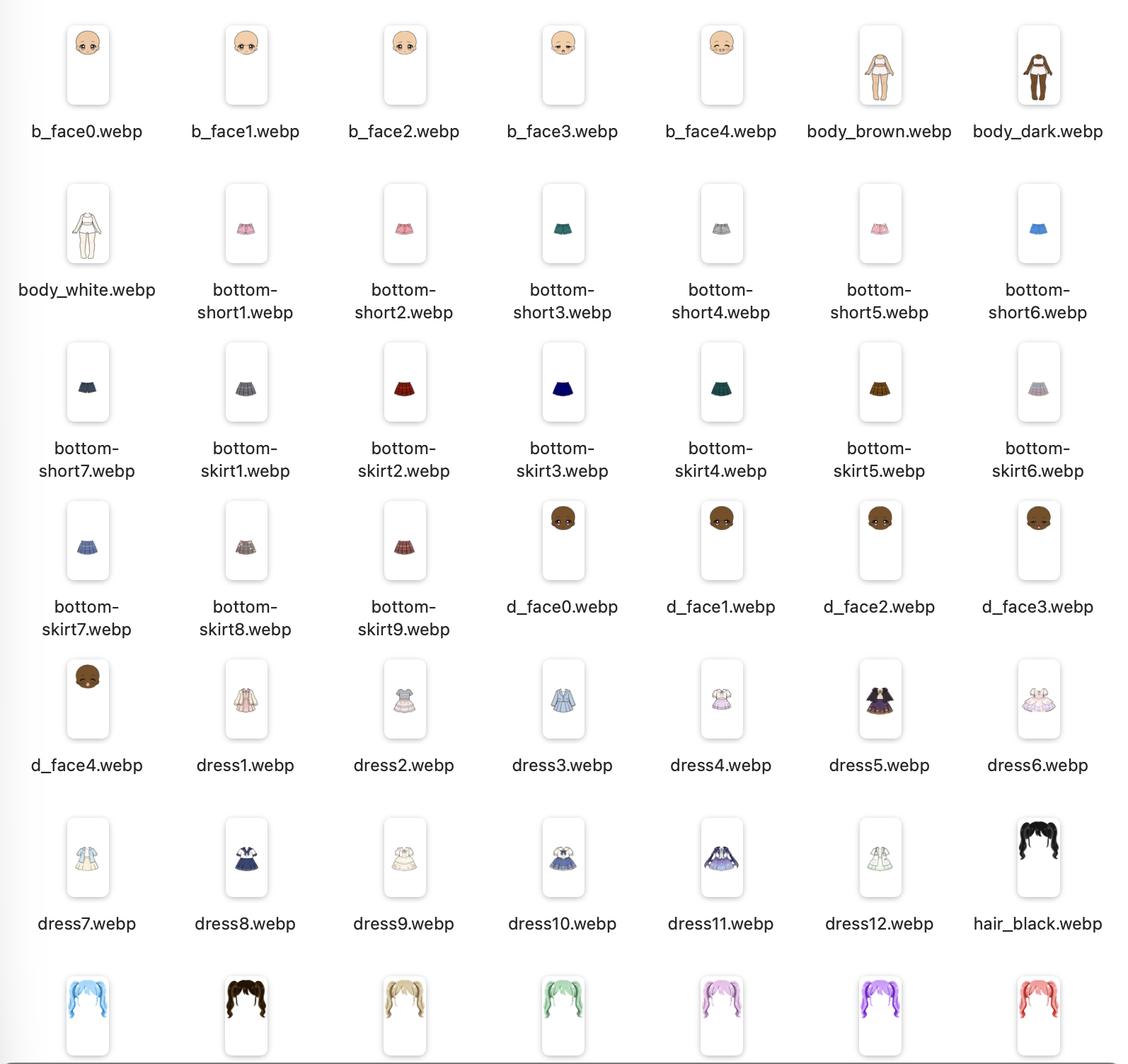
I also worried too many images would hurt load time. In practice they were compressed to WebP with transparency kept, and loaded on demand. The page feels fine; Vercel analytics look strong too — aside from access limits in mainland China.
When the build was ready I let my daughter try it. She usually has little patience with toys; this was the best session yet. She played for nearly an hour straight — a personal record — and that gave me confidence the project was actually playable and worth something.
I let her act as product designer, with me steering the thinking. Later she wanted interaction with props, level-clearing like a game, and little mini-games.
Those features are not easy. Prop interaction means generating and slicing many scene elements, then placing each small piece by hand in a large scene. Mini-games and rewards — coins, XP, unlocking outfits — add whole new dimensions. “Clearing levels” needs both simple game logic and level balance.
The simplest updates are still new outfits and new scenes.
I did a little promotion. I expected it would be hard to find the audience. Hosting on Vercel also cuts off most users in China; abroad, some parents with kids might care. Traffic is in the tens to hundreds, single digits per day — far from ads or membership revenue.
The project is also very simple, so retention is hard. To improve that I would probably need mini-games, rewards, daily tasks, and the like.
One more note: the YouTube video below is voiced by me. I thought my own voice would feel more honest than AI and bring better numbers. It did worse than later AI versions — though that may not be the main factor next to content and overall quality.