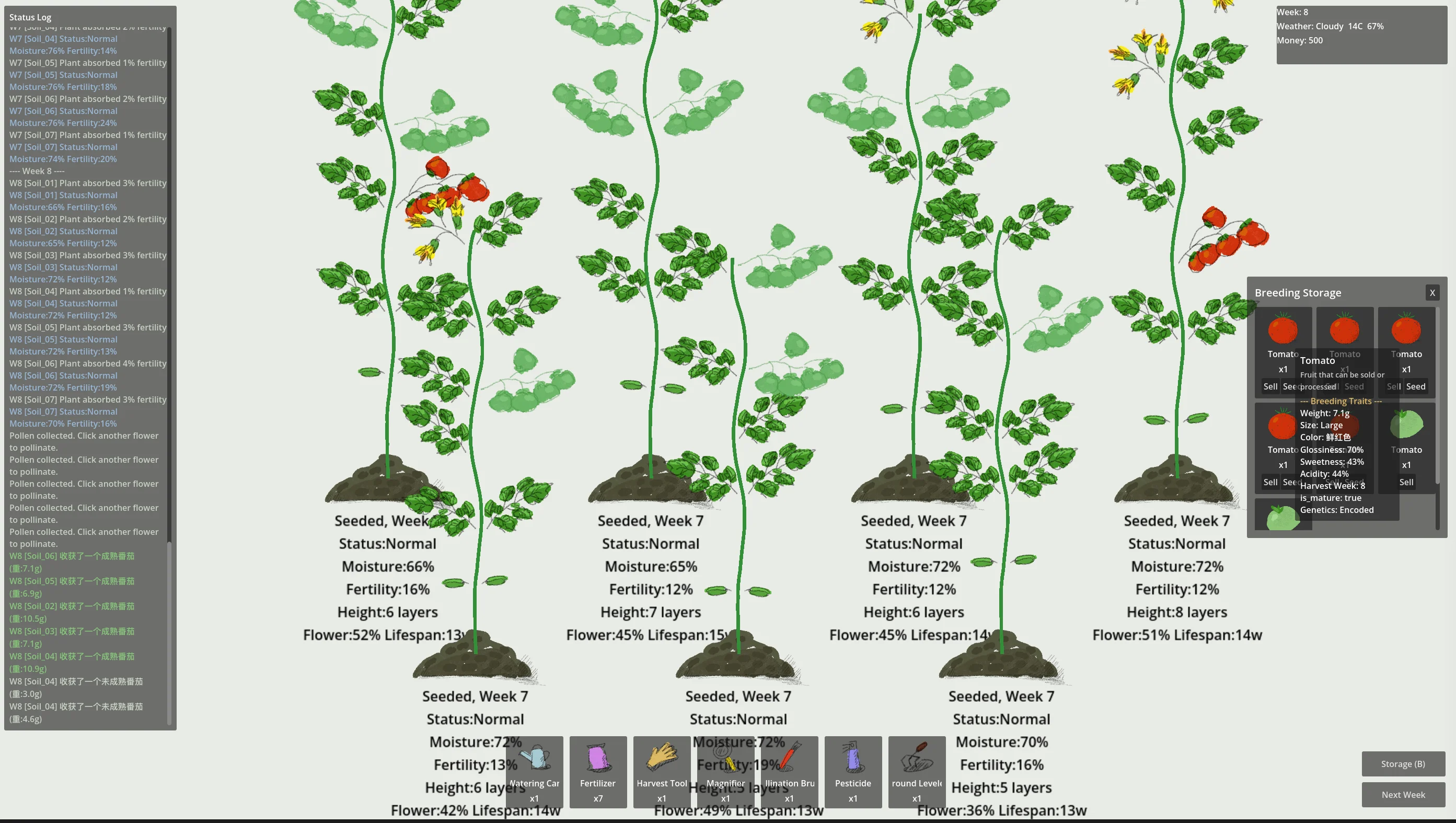
This was a client game I made on my own — not a mini game. Around that time I was deep into growing plants and watching a lot of care tutorials. I have always liked simulation games and have sunk plenty of hours into them on Steam. Genetics and evolution interest me too. So I set out to make The Breeders Handbook.
The core idea is tending one kind of plant, hand-pollinating for offspring of different quality, and doing manual genetic selection. While you raise them you also balance light, water, air, and so on so the plant lives in the right environment. Crops you breed yourself — tomatoes, for example — can go to market. Money from sales goes into new gear and better seeds, which closes the feedback loop.
It is a slow, fairly hardcore breeding sim. You have to commit to it.
My target was Steam indie. Compared with the noisy, often rough mini-game market, I prefer Steam’s indie scene and its more seasoned players.
I built it in Godot, again learning as I went with AI help, and ended up with a full-loop demo you can play on itch. In that build you grow tomatoes, use various tools, and every plant part is modeled abstractly: stems, leaves, flowers. At the right stage flowers become fruit; fruit has several stages too. Leave it unpicked and the whole plant can wither under certain conditions.
The plant is simulated as layers of foliage and flowers. Each layer grows upward, randomly branching left and right into leaves or flower/fruit shoots.
Art was the hard part. I bought a drawing stylus and painted the main assets myself on an iPad. I came to see how extreme indie games are about art — success or failure often hangs on how the visuals feel.
I was not happy with my own drawing. I mostly traced over a copyrighted tomato-growth reference, which left little invention. When I tried drawing freehand without the reference, proportion and realism still fell short. And no matter how I approached it, whenever I tried to make it look good I drifted back toward that reference. Credit where it is due: that reference is close to perfect.
For this round of hand-painting I bought Procreate — the first time I tried drawing game assets myself. It was harder than I expected, and easy to get restless over. In the end I finished the main tomato assets and tried a few styles before settling on what the game uses now.
Code did not go smoothly either. Godot felt awkward on a first pass. I had under-thought the architecture for a sim like this, so late in the project AI was basically driving everything, which made me uneasy. On earlier mini games I still held some control of the overall structure. Here it became: I state a need, file a bug, AI patches it. Some issues I could not even understand how they arose. As a developer I call that AI going off the rails — and it is dangerous.
I shipped the itch build and posted it in a new-game thread. Traffic was almost nothing, so I dropped further development.
Much later I saw someone else on Bilibili shipping a plant-genetics sim with overlapping ideas. I left a comment under her video and shared screenshots of mine. Hers was further along, but without my hand-drawn look — closer to a pure text strategy game. That comment got a fair number of likes; a few people even said they were interested in the concept. That felt good.
Maybe one day I will revive this project and ship it on Steam as a real indie title. That remains one of my life goals.